
Política
Saab entregado: el chavismo ahora dice que nunca fue venezolano
** El régimen entregó a Alex Saab a Estados Unidos el sábado 16 de mayo de 2026. Dos días después, Diosdado Cabello afirmó que Saab nunca fue venezolano. Registros del SAIME, IVSS y el Registro Electoral cuentan otra historia.

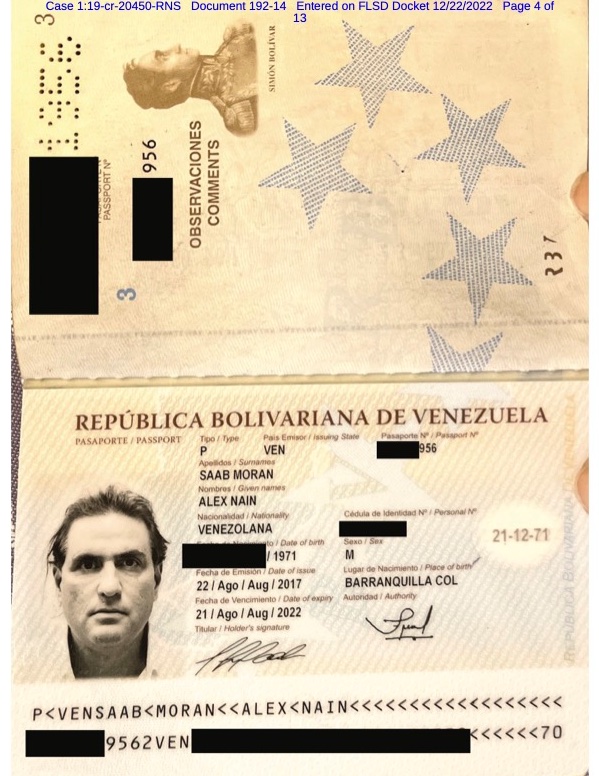
El sábado 16 de mayo el Gobierno de Delcy Rodríguez deportó a Alex Saab a Estados Unidos. El lunes 18, el ministro Diosdado Cabello aseguró que Saab «no es venezolano» y que su cédula nunca fue legal. Los registros públicos del SAIME, del IVSS y del Registro Electoral muestran lo contrario. Saab incluso votó el 28 de julio de 2024.
El avión aterrizó en Miami la noche del sábado 16 de mayo. Bajó Alex Naín Saab Morán, 54 años, empresario de origen colombiano. Hasta el 3 de enero de 2026 fue ministro de Industria del gobierno de Nicolás Maduro. Hasta hace meses fue defendido públicamente por el chavismo como «enviado especial» del régimen y, antes, como prisionero político cuando estuvo detenido en Cabo Verde (2020-2021) y luego en Estados Unidos (2021-2023).
El lunes 18 fue presentado ante la Corte del Distrito Sur de Florida en Miami. Los cargos: lavado de dinero, conspiración para realizar transacciones financieras, ocultación del origen de fondos. La DEA confirmó horas después que la causa busca «desmantelar redes ligadas al chavismo». Saab permanece detenido a la espera del proceso.
La declaración
A primera hora de ese mismo lunes, Diosdado Cabello dio una rueda de prensa en sede del PSUV. Allí lanzó una afirmación que reordena —al menos en el discurso oficial— la última década de la presencia pública de Saab en Venezuela.
«Alex Saab no es venezolano. No lo es», dijo Cabello. «Es un ciudadano de origen colombiano, presentó siempre una cédula venezolana que no es una cédula legal, no tiene ningún tipo de sustento dentro del SAIME, que es el organismo que otorga la cédula de Venezuela».
Agregó: «Él mostró una cédula que no es legal, con una fecha de emisión de 2004. Si sacan la cuenta de su presencia en Venezuela, se darán cuenta de que es fraudulenta. Hicimos una investigación detallada y no hay ningún expediente en SAIME que certifique que es una persona venezolana».
Cierre del ministro: «Que la justicia se encargue, nosotros hicimos lo que nos corresponde aquí».
Lo que dicen los registros
La Unidad de Investigación de El Pitazo publicó el mismo lunes una verificación que contradice frontalmente la versión de Cabello. Según fuentes del archivo de venezolanos cedulado, el número V-21.495.350 aparece asignado a «SAAB MORAN, ALEX NAIN, M, 1971-12-21» desde 2018.
Saab aparece, además:
- En el Registro Electoral del Consejo Nacional Electoral. Su primer voto registrado data del 28 de julio de 2024, día de la elección presidencial. El propio Saab publicó entonces fotografías en su cuenta de X mostrando que había sufragado.
- En el sistema del SENIAT con RIF activo como contribuyente.
- En los registros del Instituto Venezolano de los Seguros Sociales (IVSS) con cotizaciones a su nombre.
- Como titular de pasaporte diplomático venezolano, documento que sirvió como argumento central para la campaña de liberación que el régimen sostuvo cuando estuvo detenido en Cabo Verde en 2020.
El diario El Tiempo de Bogotá precisó otro punto que la declaración de Cabello no aborda: si Saab no era venezolano, no se explica por qué se le otorgó pasaporte diplomático, por qué se montó una campaña internacional pidiendo su liberación, por qué se le declaró «enviado especial» del Estado venezolano, ni por qué Maduro lo designó ministro de Industria en octubre de 2024.
La operación retroactiva
La maniobra es conocida en la gramática del poder: borrar el rastro institucional de quien ya no conviene. Es el mecanismo opuesto al utilizado durante años, cuando Saab era presentado como «víctima» y «defensor de la soberanía venezolana». La cédula que sostenía esa narrativa era legal mientras Saab era útil. Hoy, según el ministro, ya no lo es.
La opositora Andrés Velásquez, citado por CiberCuba, sintetizó: «Las acusaciones van y vienen de un bando y otro». La división interna del chavismo —rodrigato versus madurismo— se profundiza con cada movimiento. La entrega de Saab no solo descarga responsabilidades penales hacia Estados Unidos: descarga también, hacia el pasado, la complicidad institucional que el régimen actual heredó.
El valor de Saab para la fiscalía estadounidense reside en su conocimiento operativo. Según el expediente, conoce la arquitectura financiera del chavismo: las redes de testaferros, las estructuras offshore, los esquemas de evasión de sanciones, los corredores de oro entre Venezuela y Turquía, los pagos cruzados con intermediarios europeos.
Su declaración en Miami —en la medida en que decida cooperar— puede sostener nuevos cargos contra Maduro y Cilia Flores, hoy detenidos en Estados Unidos, y abrir investigaciones contra figuras del rodrigato que ahora intentan presentarse como tecnócratas de transición.
Lo que queda
La declaración de Cabello sobre la cédula de Saab es una pieza de un patrón más amplio que define al Estado venezolano contemporáneo: los documentos no certifican realidad. Certifican lo que el poder necesita en cada momento. Hoy Saab tiene cédula fraudulenta. Mañana, otro la tendrá. El acta. El registro. El expediente. Todo es maleable cuando la utilidad política cambia.
El miércoles 20 de mayo, INCÍSOS firma en su columna del editor un Inciso titulado «Cédula chimba» que examina ese patrón completo.
- —
Fuentes principales
- *Semana* (Colombia): https://www.semana.com/mundo/articulo/diosdado-cabello-nego-que-alex-saab-fuera-venezolano-mostro-una-cedula-que-no-es-legal/202648/
- *El Universo* (Ecuador): cobertura del 18 de mayo de 2026.
- *El País* (Cali): https://www.elpais.com.co/mundo/diosdado-cabello-afirma-que-alex-saab-tenia-cedula-venezolana-fraudulenta-delcy-rodriguez-tambien-hablo-tras-la-deportacion-1839.html
- *El Pitazo* (Venezuela), Unidad de Investigación: «Los rastros de Álex Saab en el sistema venezolano: RIF, seguro social y registro electoral» (18 de mayo de 2026).
- *El Tiempo* (Bogotá): «Diosdado Cabello asegura que Alex Saab no es venezolano y que portaba una cédula falsa» (18 de mayo de 2026).
- *La Patilla*: cobertura editorial del 18 de mayo de 2026.
- *Confirmado* (Venezuela): cobertura del 18 de mayo de 2026.
- *CiberCuba*: declaraciones de Andrés Velásquez (18 de mayo de 2026).
- Rueda de prensa del PSUV (lunes 18 de mayo de 2026, video difundido vía cuentas oficiales y replicado por Luigino Bracci Roa en X).
Este análisis se publica bajo los criterios editoriales de INCÍSOS. Cómo trabajamos →
Alfredo Yánez
9 libros que te cambian la perspectiva
Finanzas, emprendimiento, migración y más — disponibles en Amazon
VER LIBROS →


Política
Immigrants have been incarcerated less than the native-born since 1870
The longest available series covers a century and a half and records no period in which immigrants were incarcerated more than the American-born.

INCÍSOS SPECIAL · HEIRS
Leer en español
The association between immigration and crime is probably the most repeated and least supported claim in American public debate. A century and a half of data exists to test it.
| What | Immigrants have recorded lower incarceration rates than the American-born since at least 1870. |
| Who | Researchers at the National Bureau of Economic Research; researchers published in PNAS. |
| When | A 150-year series, from 1870 to 2020. The Texas study covers 2020. |
| Where | The United States, with specific analysis of Texas state records. |
| Why | It is the empirical basis contradicting the most-used argument against immigrant presence. |
| How | Historical censuses and administrative arrest and conviction records. |
The long series
A study published by the National Bureau of Economic Research reconstructed incarceration rates for immigrants and the American-born across 150 years, from 1870 — the first year with available records — to the present.
The result admits no nuance of trend: in no period of that series did immigrants record incarceration rates higher than those of people born in the United States.
In 2020, immigrants were 60 percent less likely to be incarcerated than people born in the country, according to that same work. Compared specifically with white Americans born here, the difference was 30 percent lower.
The gap, moreover, has widened over time.
The Texas records
A study published in 2020 in the Proceedings of the National Academy of Sciences analyzed administrative arrest and conviction records from Texas, one of the few states that records the immigration status of those detained.
The results per thousand residents: immigrants, including those without legal status, were roughly half as likely to be arrested for violent crimes as the native-born. Around 40 percent as likely for drug offenses. Around 25 percent for robbery and property crimes.
Texas matters as a case because it is a border state, with one of the country’s largest immigrant populations, under an administration that has not been permissive on immigration enforcement. The data are its own.
A caution about sources
The most-cited data series in this area comes from the Cato Institute, which publishes annual estimates of incarceration rates by immigration status. Its 2024 figures put the rate at 1,195 per 100,000 among the American-born, 674 among immigrants in irregular status and 303 among immigrants with legal status.
The Cato Institute is a research center with a declared position favoring immigration openness. Its figures point in the same direction as the academic ones and serve as corroboration, but the argumentative weight of this piece rests on the 150-year study and the PNAS work, both peer-reviewed.
What these data do not settle
Aggregate rates say nothing about individual cases. Every crime committed by an immigrant exists, has victims and merits the same institutional response as any other.
Nor do they explain why the gap exists. The available hypotheses — self-selection among those who emigrate, risk aversion tied to losing status, age structure, family composition — are plausible and unresolved.
What they do establish, with the longest available series and with independent administrative records, is that the opposite premise has no empirical support in any stretch of a century and a half.
Why it is in this special
A community assigned a criminal propensity the data do not support carries a cost that is not symbolic. That cost translates into public policy, into enforcement budgets, into daily treatment, and into the rest of the country’s willingness to consider it part of itself.
Hispanic heritage includes that too: having carried, for a century and a half, an accusation the country’s own records refute.
Primary sources: National Bureau of Economic Research, study of immigrant incarceration rates across 150 years (Abramitzky, Boustan, Pérez and others), also distributed by the Migration Policy Institute. Proceedings of the National Academy of Sciences, 2020 study of Texas arrest records. Cato Institute, annual series on incarceration rates by immigration status, identified as a center with a declared position.
Política
MS-13 was born in Los Angeles and came back deported
Between 1996 and 2002, the United States sent roughly 31,000 convicts to Central America. The criminal structure now attributed to the region was built in the north.

INCÍSOS SPECIAL · HEIRS
Leer en español
A special on Hispanic heritage would be incomplete without the part nobody wants to claim. The documentary record places it somewhere other than where it is usually assigned.
| What | MS-13 formed in Los Angeles in the 1980s and went transnational by way of American deportation policy. |
| Who | Refugees fleeing the Salvadoran civil conflict; the United States government; the countries of northern Central America. |
| When | Formation in the 1980s. Mass deportations between 1996 and 2002. |
| Where | California first; El Salvador, Honduras and Guatemala after. |
| Why | The conventional account reverses the direction of the phenomenon, and with it the explanation. |
| How | Mid-1990s legislation expanded the universe of noncitizens subject to removal, including convicts with gang ties. |
Where it formed
The Congressional Research Service, in its report on the organization, establishes that MS-13 formed on the streets of Los Angeles during the 1980s, made up of people fleeing the Salvadoran civil conflict.
The same document notes it was constituted in part as protection against Latino gangs already operating in the city, among them Barrio 18. The «13» refers to the thirteenth letter of the alphabet, reflecting its tie to the Mexican Mafia within the California prison system.
None of that origin occurred in Central America.
How it crossed south
Legislation passed in the mid-1990s substantially expanded the universe of noncitizens subject to detention and removal, including those with criminal convictions.
Between 1996 and 2002, the United States sent roughly 31,000 convicted people to Central American countries, of whom some 12,000 went to El Salvador, according to documentation from the Washington Office on Latin America.
The Congressional Research Service records that the organization became transnational when members deported from the United States established its structure in Central America.
The receiving countries had institutions weakened by decades of civil war, with no absorption capacity, no reintegration programs and in many cases no prior information about the records of those arriving.
The structure did not migrate. It was exported.
Why the direction matters
The correction is not an academic footnote. It determines which explanation is accepted and which policy follows from it.
If the organization is a Central American phenomenon that entered the United States, the logical response is to close the entrance.
If it is an American phenomenon that was exported and returned, the response has to include what happened here: how it formed, under what conditions of urban marginalization, inside what prison system, and what effect deporting tens of thousands of people to countries unable to receive them produced.
The record supports the second reading, and it does so not from an immigrant advocacy organization but from Congress’s own research service.
What this piece does not argue
MS-13 has committed serious, documented crimes on both sides of the border. Its victims have overwhelmingly been people from the same communities of origin. Nothing above mitigates that or attempts to.
Nor does it suggest the United States is solely responsible for a phenomenon shaped by civil wars, institutional collapse, poverty and decisions by several governments.
What the record does establish is the direction of the origin. And that direction is rarely told.
The uncomfortable inheritance
Every large community produces criminality, and the Hispanic community is no exception. A special that listed only celebrable contributions would be promotion, not journalism.
But the uncomfortable part is not the one usually told either. The conventional version presents an imported product. The documentary record describes something else: a structure that formed in an American city, was professionalized in an American prison system, and was installed to the south by an American policy decision.
That too is part of what has to be inherited.
Primary sources: Congressional Research Service, report R45292 on MS-13. Washington Office on Latin America, documentation on deportations of convicts to Central America between 1996 and 2002. InSight Crime, organizational profile.
Política
The proclamation celebrates the Hispanic who is a citizen and in uniform
The official text celebrating Hispanic heritage defines whom it celebrates: citizens, service members, police and border agents. The boundary is written down.

INCÍSOS SPECIAL · HEIRS
Leer en español
A commemorative month does not describe a community. It defines one. The text proclaiming it contains that definition, and it rewards careful reading.
| What | The 2025 proclamation recognized Hispanic-American citizens and singled out those serving in military, law enforcement and border security roles. |
| Who | The White House, author of the text; the 70.1 million Hispanics the Census counts. |
| When | Signed September 22, 2025, seven days after the period began. |
| Where | The United States. |
| Why | The proclamation marks out who official recognition reaches and who it does not. |
| How | Public Law 100-402 requires an annual presidential proclamation for the month to be observed. |
The month exists because it gets signed
The 1988 law authorizes and requests the president to issue an annual proclamation designating September 15 through October 15. Without that signature, there is no proclaimed observance. Every president since 1990 has issued one.
The 2025 proclamation was signed September 22. The period had begun on the 15th.
Seven days is not on its own a declaration of anything. Proclamations are signed with variable margins. But the fact is on the record and worth noting before reading the text.
What the text says
The 2025 proclamation recognizes the contributions of Hispanic-American citizens. It singles out Hispanic patriots who have served on the front lines of the military, in law enforcement and in border security. It speaks of defending national sovereignty and protecting the flag.
Each of those elements is legitimate. There are Hispanic citizens. There are Hispanics in the armed forces and in federal security agencies. Their service exists and merits recognition.
What matters here is not what the text affirms, but its perimeter.
The perimeter
The 70.1 million people the Census Bureau counts as Hispanic include citizens by birth, naturalized citizens, permanent residents, people with temporary status, asylum seekers and people without regular status.
The proclamation names citizens. And among them, it underscores those in uniform.
That is not a description of the Hispanic community in the United States. It is a subset of it, defined by two criteria: legal status and function in service to the state.
A commemorative text obligates no one and appropriates nothing. But it establishes the official terms of a recognition, and those terms leave out a substantial portion of the people whose contribution the same proclamation celebrates in the abstract.
The context of the signing
During the same period, other figures describe the state’s relationship with that population.
An analysis of immigration enforcement data reported by specialized press records 49,571 ICE arrests in July 2026, the highest monthly total of the second term, up roughly 15 percent from June, with more than half of those detained having no convictions or pending charges. The figure comes from a processing of federal data and should be verified against the original source before being treated as settled.
The Congressional Budget Office projects net migration of roughly 570,000 people for 2026, well below earlier projections nearing two million.
And a Pew Research Center survey from November 2025 found that 47 percent of Latinos surveyed felt less safe in their area because of deportation actions.
What remains
An annual proclamation celebrates Hispanic heritage. A simultaneous policy reduces Hispanic presence, polices it and displaces it.
Both occur under the same signature and on the same calendar.
No intent needs to be assigned to observe the contradiction. It is enough to place the two documents side by side and read the dates.
Primary sources: Proclamation on National Hispanic Heritage Month 2025, signed September 22, 2025. Public Law 100-402. U.S. Census Bureau, Facts for Features CB26-FF.07. Congressional Budget Office, net migration projections. Pew Research Center, November 2025 survey. Immigration arrest data processed by the Deportation Data Project, as reported by specialized press.
-

 Entrevistas3 meses ago
Zair Mundaray: «Enfrenté al poder con ciencia»
-

 Política2 meses ago
Delcy Rodríguez enfrenta a la prensa internacional: la rueda de prensa que no cerró la brecha
-

 Política4 meses ago
El economista, los bonos y Citgo
-

 Política4 meses ago
Roberto Smith Perera: «La reconstrucción no puede esperar a la elección»
-

 Política2 meses ago
El semáforo de las estructuras: qué significa cada color tras el terremoto
-

 Especiales3 meses ago
Media vuelta… mar.
-

 Inciso4 meses ago
La paciencia de Washington
-

 Inciso4 semanas ago
Márquez sabe qué pasó el 28 de julio