
Aquí en Columbus
Your broken stove isn’t just your problem: what Ohio law requires of your landlord
A broken appliance your landlord won’t fix is a violation of Ohio law, not a pending favor. This is the guide to asserting your rights without risking your home.


A tenant at an apartment complex in Worthington documented that her broken stove scorches her pots and ruined food and utensils. Management promised to replace it, and more than three weeks passed with no fix. In Ohio, that is not a pending favor: it is an unmet legal obligation.
| Question | Answer |
|---|---|
| What | A broken stove the landlord won’t repair, despite the tenant’s documented complaint. |
| Who | Apartment tenants and the management or owners legally required to make repairs. |
| When | A recent case in Worthington has gone more than three weeks without a fix. |
| Where | Worthington and the greater Columbus area, in Franklin County. |
| Why | Ohio law requires the landlord to keep the home habitable, including supplied appliances. |
| How | Through written notice, documentation, and, if unanswered, the rent escrow process in court. |
A case that repeats more than it’s told
A tenant at an apartment complex in Worthington complained and documented that her stove is broken: it scorches her pots and has cost her utensils and food. Management received the complaint and said it would replace the appliance. More than three weeks have passed and the problem persists. It is a story that repeats across the Columbus area, and many Hispanic tenants live it in silence, unaware that the law is on their side.
Because that is what this comes down to: in Ohio, an essential appliance that the landlord supplies and that breaks is not an inconvenience the tenant must resign themselves to tolerating. It is the landlord’s legal responsibility. Knowing the difference between asking for a favor and demanding a right changes everything.
What the law requires of the landlord
Ohio law is clear. The Ohio Revised Code, in section 5321.04, places on the landlord the duty to keep the home in habitable condition. That duty includes keeping in working order the appliances the landlord supplied as part of the rental, when the lease so provides. A stove supplied with the apartment falls into that category.
That duty, moreover, cannot be delegated or shifted onto the tenant through a lease clause. Even if the lease says the tenant maintains the appliances, the underlying obligation to keep the home habitable remains the landlord’s. The tenant is only responsible for damage they themselves caused through negligence.
What the tenant should and should NOT do
Here is where many tenants, with every reason to be angry, make a mistake that costs them dearly. In Ohio there are two things a tenant may NOT do, even though they seem logical:
- They may not stop paying rent as a form of pressure. Withholding rent on your own is not legal in Ohio and can become grounds for eviction.
- They may not repair the problem themselves and deduct the cost from rent. That mechanism, known as «repair and deduct,» is generally not permitted in Ohio.
What the tenant SHOULD do is build a solid record, because documentation is their greatest protection:
- Give written notice. A phone call or verbal message is not enough. An email, a text, or a letter creates a dated record. Keep a copy of everything.
- Document the damage. Photos and videos of the stove, the scorched pots, the spoiled food. Each piece of evidence with its date.
- Save all communication with management. Promises to «replace it» carry weight when they are in writing.
- Keep paying full rent on time. This point is decisive: to access the legal mechanisms, the tenant must be current.
The formal path: rent escrow
When the landlord does not respond, Ohio law offers a concrete tool: depositing rent with the court, known as rent escrow, set out in section 5321.07 of the Ohio Revised Code. Instead of paying the landlord, the tenant deposits the rent with the court, which does not release that money to the landlord until the repairs are made.
The requirements, verified, are these. First, having given the landlord written notice. Second, having waited a reasonable amount of time: up to 30 days for most defects, or around five days when it is a serious emergency (such as no heat in winter, no water, or no electricity). Third, being current on rent.
In Franklin County, the process is handled at the Franklin County Municipal Court, Rent Escrow Division, located at 375 S. High Street, third floor. Payment is accepted only in cash or money order. The court retains 1% of each rent payment deposited. There is no filing fee to start it. For questions about the escrow program, the number is (614) 645-8576. When filing, the tenant may also request mediation and ask for a repair order.
Jurisdictional note: although Worthington is a city with its own government within Franklin County, rent escrow is filed with the Franklin County Municipal Court.
The code complaint, an effective shortcut
There is a path that often works faster than escrow: filing a complaint with Code Enforcement, the office that enforces the local housing code. When an inspector independently verifies that a code violation exists and formally notifies the landlord, that official determination becomes powerful evidence.
Worthington runs its own Code Enforcement, through its Planning & Building Division, and is not governed by the City of Columbus 311. A Worthington tenant should direct their code complaint to the City of Worthington (worthington.org, Planning & Building, open weekdays starting at 7:30 a.m.), not the Columbus 311. A tenant within the City of Columbus limits uses 311 to report.
Reporting without fear: protection against retaliation
The most common fear, especially among Hispanic tenants, is that complaining will bring retaliation: a rent increase, an eviction attempt, harassment. It is a legitimate fear, and the law anticipates it. Columbus has an anti-retaliation ordinance that protects tenants who report code violations, and Ohio law also prohibits a landlord from retaliating against a tenant for exercising their rights.
Documentation protects twice: to secure the repair and to shield against payback.
Where to turn in Columbus for free help
- Legal Aid Society of Columbus: (614) 241-2001
- Legal Aid of Southeast and Central Ohio: 1-888-246-4420
- Ohio Hispanic Coalition: (614) 840-9934
- CRIS: (614) 235-5747
This article is informational and does not constitute legal advice. Each case has its own details, and for a specific situation the right step is to consult a lawyer or a legal aid organization.
What this case teaches
The stove of a tenant in Worthington looks like a small, private problem. It is not. It is an example of something larger: the gap between what a landlord promises and what the law requires them to do. That gap narrows with one thing within any tenant’s reach: paper. Written notices, dated photos, saved copies. In a housing dispute, the one who documents gains ground. And knowing that the law obligates the landlord — it does not ask them a favor — is the first step to stop waiting and start demanding.
Sources: Ohio Revised Code §§ 5321.04 and 5321.07 · Franklin County Municipal Court, Rent Escrow Division · Ohio Legal Help · COHHIO · Legal Aid of Southeast and Central Ohio · City of Worthington, Planning & Building.
Alfredo Yánez
9 libros que te cambian la perspectiva
Finanzas, emprendimiento, migración y más — disponibles en Amazon
VER LIBROS →


Aquí en Columbus
El voto anticipado en Ohio comienza el 6 de octubre
Las cuatro fechas del calendario electoral de Ohio para el 3 de noviembre.

Un día después del cierre del registro se abre la votación en persona. Las fechas que conviene anotar antes del 3 de noviembre.
| Qué | El voto anticipado en persona comienza el martes 6 de octubre. |
|---|---|
| Quién | Votantes registrados en Ohio. |
| Cuándo | Del 6 de octubre al 3 de noviembre de 2026, con plazos intermedios. |
| Dónde | En la junta electoral de cada condado; en Columbus, la de Franklin County. |
| Por qué | Votar antes reduce el riesgo de imprevistos el día de la elección. |
| Cómo | En persona en la junta del condado o por boleta enviada por correo. |
Las cuatro fechas
- Lunes 5 de octubre: último día para registrarse o actualizar la dirección.
- Martes 6 de octubre: comienza el voto anticipado en persona.
- Martes 27 de octubre: la solicitud de boleta por correo debe llegar a la junta electoral a más tardar ese día.
- Martes 3 de noviembre: día de la elección. Los centros abren de 6:30 a 19:30.
Por qué votar antes conviene
Un turno de trabajo que se alarga, un carro que no arranca o una fila larga bastan para perder el voto. El período anticipado, que va desde el 6 de octubre, permite elegir el día y la hora con menos presión.
Qué se elige
En Ohio se vota, entre otros cargos, por el escaño del Senado de EE.UU. y por la gobernación, además de la Cámara de Representantes federal y cargos estatales y locales. En carreras que las encuestas de septiembre muestran cerradas, el margen puede ser de pocos miles de votos.
Antes de ir
Confirme su registro y su lugar de votación en el sistema de la Secretaría de Estado de Ohio. Si se mudó dentro del condado, actualice la dirección antes del 5 de octubre. Si recibió un aviso sobre su estatus en el padrón y es ciudadano, respóndalo: de lo contrario, su registro puede cancelarse.
Solo pueden votar ciudadanos estadounidenses. Registrarse o votar sin serlo tiene consecuencias migratorias y penales graves.
Fuentes principales
- Secretaría de Estado de Ohio, calendario electoral 2026.
- Bowling Green State University, BGSU Votes, y Headcount.org, fechas de la elección general.
Aquí en Columbus
Nueve días: qué cambia el 3 de octubre para un trabajador
Qué cambia en el empleo cuando vence el TPS y a quién llamar en Columbus.
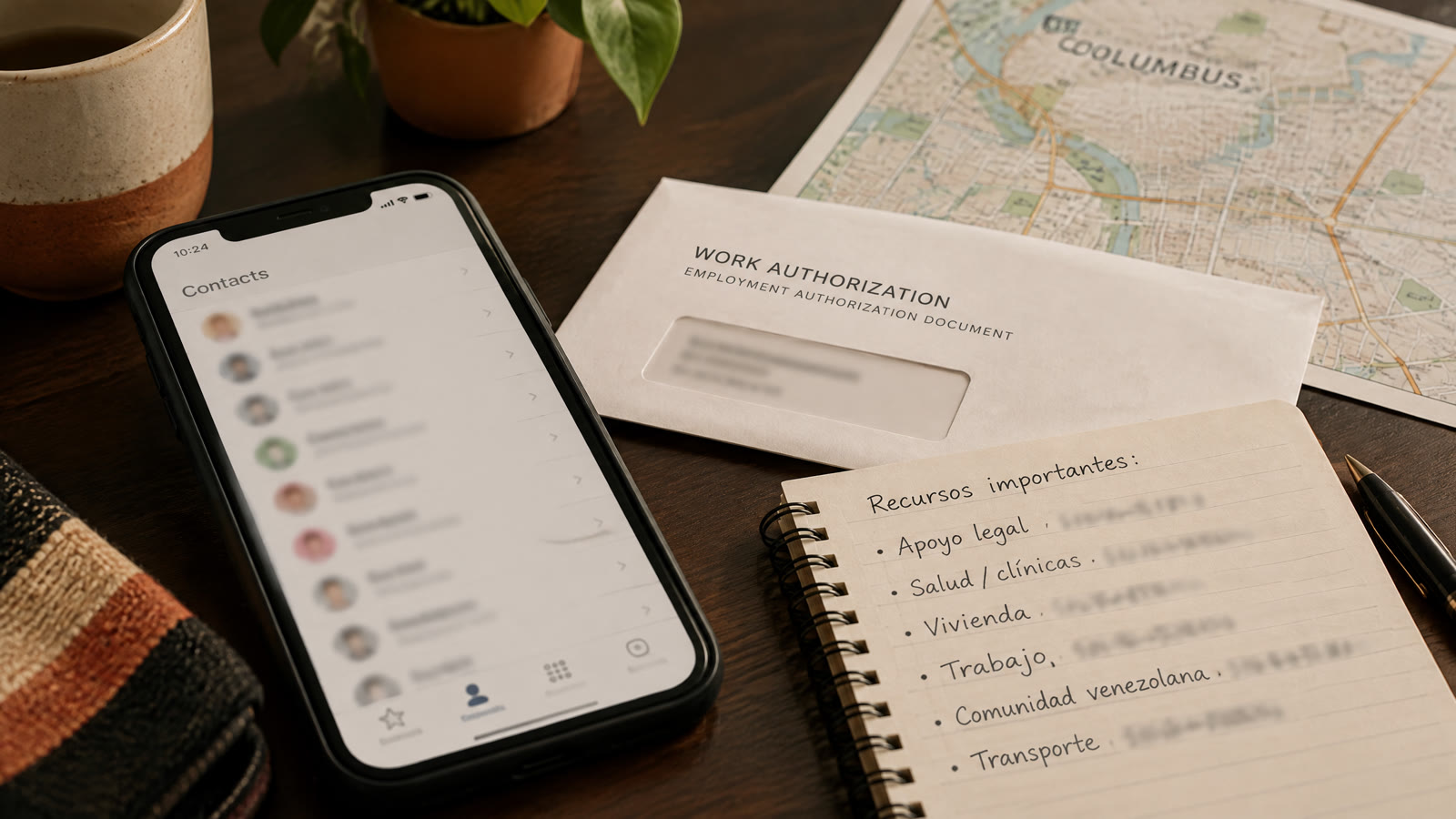
El vencimiento del TPS venezolano se siente primero en la nómina. Qué conversar con el empleador antes de la fecha y a quién llamar en Columbus.
| Qué | El vencimiento del 2 de octubre obliga a empleadores a reverificar la autorización de trabajo. |
|---|---|
| Quién | Trabajadores venezolanos con TPS en Columbus y sus empleadores. |
| Cuándo | Faltan nueve días. |
| Dónde | Columbus y el condado de Franklin. |
| Por qué | La pérdida de autorización afecta salario, seguro médico y alquiler. |
| Cómo | Con revisión de documentos y asesoría legal antes de la fecha. |
Faltan nueve días. Para quien está cubierto por la orden judicial vigente, el efecto del 2 de octubre de 2026 se siente primero en el trabajo.
Lo primero: confirme si le aplica
Revise la fecha de emisión y la de vencimiento de su permiso de trabajo (EAD), su aviso I-797 y su I-94. La validez actual alcanza a documentos emitidos hasta el 5 de febrero de 2025 con vencimiento el 2 de octubre de 2026.
Lo que su empleador puede y no puede hacer
Puede pedirle que actualice su formulario I-9 cuando el documento venza.
No puede exigirle un documento específico, despedirlo antes del vencimiento por suponer que perderá el permiso, ni aplicar el procedimiento solo a trabajadores de una nacionalidad.
Prepare la conversación
Hable con su empleador antes de la fecha, no después. Si tiene otra solicitud pendiente que le dé autorización de empleo, lleve el número de recibo. Guarde copia de todo lo que entregue.
Teléfonos en Columbus
- Ohio Hispanic Coalition: 614-840-9934.
- Catholic Migration Services: 614-228-7977.
- Legal Aid Society of Columbus: 614-241-2001.
- Legal Aid Central Ohio (línea gratuita): 1-888-246-4420.
- CRIS, Línea FAMILIA: 614-583-8739.
Y una advertencia
Nadie puede venderle una extensión del TPS. Los formularios de USCIS son gratuitos en uscis.gov, y un «notario» no es abogado en Estados Unidos.
Esta nota tiene fines informativos y no constituye asesoría legal. Cada caso migratorio es distinto: consulte a un abogado de inmigración o a un representante acreditado por el Departamento de Justicia.
Fuentes principales
- USCIS, página de TPS para Venezuela e I-9 Central.
- Directorio de recursos verificados de Aquí en Columbus.
Aquí en Columbus
El Mes de la Herencia Latina sigue en Columbus hasta octubre
Cómo seguir las actividades del Mes de la Herencia Latina en Columbus hasta el 15 de octubre.

El desfile y el festival pasaron, pero el calendario del mes se extiende hasta el 15 de octubre. Cómo encontrar lo que queda sin depender de publicaciones sueltas.
| Qué | El calendario del Mes de la Herencia Hispana continúa después del desfile. |
|---|---|
| Quién | El Comité de Latino Heritage Month y organizaciones comunitarias de Columbus. |
| Cuándo | Hasta el jueves 15 de octubre de 2026. |
| Dónde | Columbus y el condado de Franklin. |
| Por qué | Buena parte de la programación ocurre fuera del fin de semana del desfile. |
| Cómo | Consultando el calendario del comité y las carteleras de bibliotecas y centros comunitarios. |
El fin de semana del desfile concentra la atención, pero el Mes de la Herencia Hispana se extiende hasta el jueves 15 de octubre de 2026.
Dónde buscar lo que queda
- El calendario del Comité de Latino Heritage Month, que organiza la programación anual desde 2022.
- Las bibliotecas públicas del condado, que suelen tener actividades familiares y bilingües.
- Los centros comunitarios y las parroquias, que publican su propia agenda.
- Las universidades del área, con programación abierta al público.
Una advertencia práctica
Las carteleras del mes mezclan con frecuencia fechas de años anteriores. Antes de salir de casa conviene confirmar tres datos: año, hora y dirección exacta. Una actividad anunciada sin año es la causa más común de viajes perdidos.
Lo que sí está fijado
El cierre del mes, el 15 de octubre. Y una fecha cívica que cae dentro de ese periodo y afecta a todos: el lunes 5 de octubre vence el plazo para registrarse a votar en Ohio.
Ayúdenos a completar la agenda
Si su organización tiene actividades programadas hasta el 15 de octubre, puede enviarlas a colabora@incisos.com con fecha, hora, lugar y contacto. Publicaremos las que podamos verificar.
Fuentes principales
- Comité de Latino Heritage Month de Columbus, programación 2026.
- Secretaría de Estado de Ohio, calendario electoral 2026.
-

 Entrevistas4 meses ago
Zair Mundaray: «Enfrenté al poder con ciencia»
-

 Política3 meses ago
Delcy Rodríguez enfrenta a la prensa internacional: la rueda de prensa que no cerró la brecha
-

 Política4 meses ago
El economista, los bonos y Citgo
-

 Política4 meses ago
Roberto Smith Perera: «La reconstrucción no puede esperar a la elección»
-

 Política3 meses ago
El semáforo de las estructuras: qué significa cada color tras el terremoto
-

 Especiales4 meses ago
Media vuelta… mar.
-

 Inciso1 mes ago
Márquez sabe qué pasó el 28 de julio
-

 Inciso5 meses ago
La paciencia de Washington